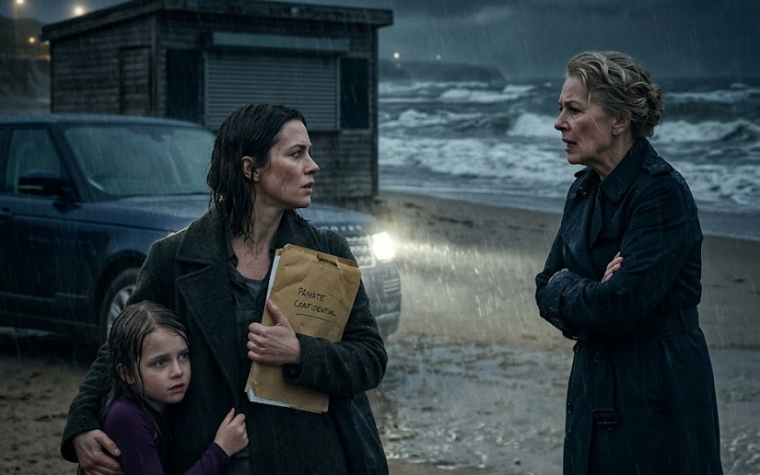
I opened the blue folder and turned the first page toward my parents.
Nobody spoke.
Eric leaned forward first.
He had spent most of the evening slouched in his chair, visibly irritated that the family emergency had interrupted whatever he would rather have been doing.
Now his eyes moved from the page to me, then to Dad.
“What is that?” he asked.
“The deed,” I said.
Dad’s jaw tightened.
Mom kept one hand wrapped around his wrist.
The document itself wasn’t new.
That was the strange part.
Everyone at the table had known about it when it was signed.
Years earlier, when foreclosure had stopped being an abstract threat and started becoming a date on a bank notice, my parents had needed more than a daughter willing to help with a few bills.
They had needed someone willing to put her own financial future on the line.
That someone had been me.
The loan had gone into my name because my credit could carry it.
The ownership structure had been changed because no competent lender—or accountant—would treat that risk casually.
In exchange for taking responsibility for the debt and keeping the property alive, I received the majority ownership interest in the house.
At the time, Dad had called it a technicality.
“It’s still the family home,” he’d said.
I had agreed.
That was before I understood that “family” meant something different depending on who was expected to sacrifice.
Eric reached across the table for the deed.
I placed my palm over it.
“You can read it from there.”
His eyes narrowed.
“What are you trying to prove?”
“Nothing.
I’m making sure we’re all working with the same numbers.”
Mom looked at the deed without touching it.
“Paige, we know you helped with the house.
No one has ever denied that.”
I almost laughed at the word helped.
Help was bringing groceries once.
Help was covering one utility bill during a bad month.
Help was not ninety-six mortgage payments.
Help was not taking out a massive loan under your own name because your parents were staring at foreclosure.
Help was not protecting your brother from the cost of his own mistakes while quietly rebuilding the savings your parents later planned to leave him.
But I didn’t argue semantics.
Instead, I removed another document from the folder.
It was a payment history.
Rows of dates.
Rows of amounts.
Eight years reduced to columns.
“Ninety-six payments,” I said.
Dad looked away.
Eric gave a dismissive shrug.
“So? You make more money than we do.”
There it was.
Not gratitude.
Not embarrassment.
Entitlement.
“Than you do,” I corrected.
He leaned back.
“Whatever.