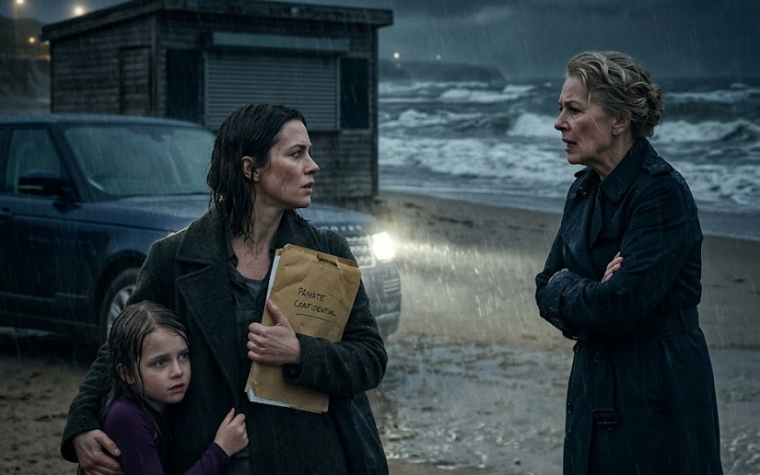
The judge’s question hung over the table.
“Emily, before this loan proceeds, I need you to identify the person who signed away your inheritance.”
Aunt Sarah sat across from me with one hand pressed flat against the polished wood.
Her son Caleb was beside her, still holding the silver pen he had intended to use on the loan agreement.
The banker had stopped arranging his papers.
The notary, June Mercer, stared at the courtroom door where two security officers now stood.
Michael remained behind my chair, rainwater darkening the shoulders of his work coat.
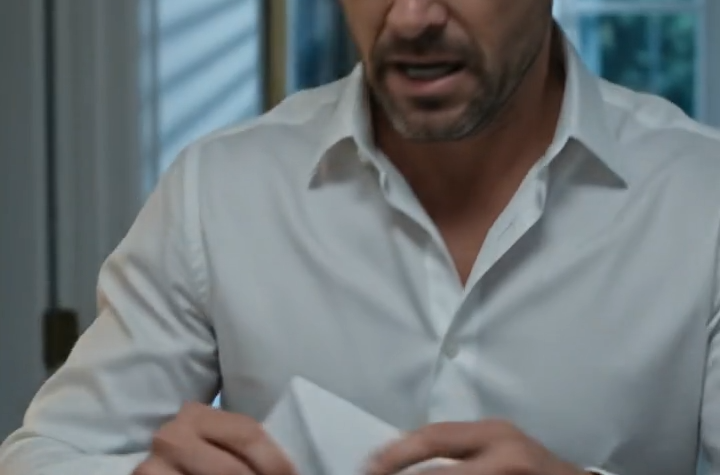
I looked down at the quitclaim deed.
My full name appeared in careful cursive at the bottom: Emily Rose Bennett.
It was close enough to fool a stranger.
The letters leaned the right way.
The final T had a long crossbar.
Whoever had copied it had studied something I had written before.
But my mother had taught me to sign my name with an open loop in the E.
The signature on the deed had a closed loop.
It also lacked the small dot I always placed beneath my middle initial, a habit my fourth-grade teacher had tried unsuccessfully to make me stop.
“That is my name,” I said.
“But it is not my hand.”
Caleb’s chair scraped backward.
“She signed it,” he said.
“She’s confused.
Look at her.
She ran away from her husband this morning.”
The judge did not look at me.
He looked at Caleb.
“Sit down.”
Caleb remained standing for half a second too long before lowering himself into the chair.
Grace Mercer, my mother’s former attorney, opened the worn leather file she had brought from her office.
She placed three school records, an old library application, and a letter I had written to my mother during her final hospital stay beside the deed.
Every authentic signature had the open E and the dot beneath the middle initial.
The forged one had neither.
Aunt Sarah recovered first.
“Emily was upset that morning,” she said.
“She signed several things and probably doesn’t remember.
I had raised her since her mother died.
I handled all her paperwork.”
Grace turned toward her.
“You handled it because you were appointed temporary guardian.
You were never made owner of her property.”
“I paid for that child for six years.”
“You were reimbursed from the survivor benefit account every month.”
Aunt Sarah’s mouth tightened.
That was the first fact I learned that morning.
For years, she had told me there was no money.
When I needed school shoes, she reminded me that charity had limits.
When the electricity was nearly disconnected, she said my mother had left nothing except debts.
I had worked evenings at a diner and handed over most of my pay because I believed I owed her for keeping a roof above me.
But according to the account statements Grace placed on the table, Aunt Sarah had received a monthly payment intended for my food, clothing, education, and medical care.
She had also withdrawn nearly all of it.
Caleb leaned toward his mother and whispered something.
The judge struck the table once with the side of his hand.
“No private conversations.”
Michael stepped forward and laid the $7,500 receipt beside the deed.
“Aunt Sarah demanded this before the marriage,” he said.
“She told me Emily’s mother had left unpaid medical expenses and that Sarah could not release her records until those costs were covered.”