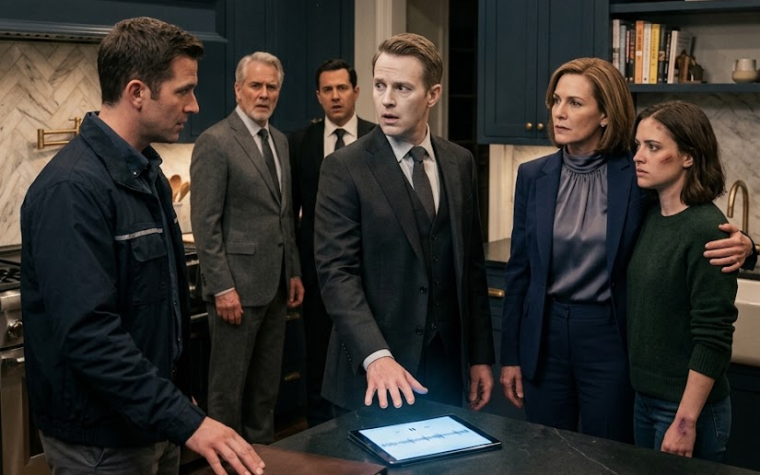
The filename appeared on the conference-room screen just as Greg lunged across the table.
Luis, the security guard who had escorted me upstairs less than an hour earlier, caught him by the arm before his hand reached the laptop.
“Don’t,” Luis said quietly.
Greg twisted free and straightened his jacket, trying to recover the authority that had always protected him.
“This is company equipment,” he snapped.
“She has no right to display stolen records.”
The woman in the navy suit stepped between him and the screen.
Her name was Mara Levin, an attorney with a whistleblower protection firm.
I had contacted her six months earlier, the night Greg ordered me to erase the audit trail connected to three suspicious vendors.
Behind her stood Special Agent Naomi Price from the Department of Transportation’s inspector general division and a forensic accountant named Daniel Cho.
At the far end of the room, Halden & Price’s chairman, Walter Halden, looked ten years older than he had during the previous board meeting.
Mara touched the trackpad and opened the file.
A payment authorization filled the screen.
Eleven separate transfers had been approved after my mother’s death.
Together they totaled $2.8 million.
Each payment had gone to one of three subcontractors supposedly owned by Eleanor Mercer.
My mother.
The woman who had spent forty years paying off a modest house, clipping grocery coupons, and refusing to replace a refrigerator until it stopped working completely.
Her name appeared beneath every transaction.
So did Greg’s digital authorization code.
For several seconds, no one spoke.
Then Greg laughed.
It was too loud and too quick.
“Anyone could have used that code,” he said.
“Claire had access to the vendor system.
This proves nothing.”
Agent Price turned toward him.
“Your code required biometric confirmation.”
Greg’s mouth tightened.
Daniel placed a small evidence bag on the table.
Inside it was a security token bearing Greg’s employee number.
“The confirmations were made with this device,” Daniel said.
“The device logged into the network from your executive office on every approval date.”
“Then someone used my office.”
“At 6:14 a.m.
on a Sunday?”
Greg looked toward Denise.
The HR director stood near the glass wall, gripping the sealed separation agreement she had tried to make me sign.
Until that moment, she had been almost invisible, the way she preferred to be whenever Greg crossed a line.
Now the whole room was watching her.
“Tell them,” Greg said.
Denise swallowed.
“Tell them what?”
“That Claire had access.
That she was unstable after her mother became ill.
That we had concerns about her judgment.”
The cruelty of it landed differently now.
In the open office, Greg had dismissed my grief as an inconvenience.
In the conference room, he was trying to turn it into evidence against me.
Mara opened another file.
“These are Ms.
Mercer’s performance reviews for five consecutive years,” she said.
“All marked exceptional.
No disciplinary actions.
No concerns regarding judgment.”